

What is out-of-band (OOB) ?
In information security, out-of-band (OOB) refers to the use of a separate, independent communication channel to perform critical security functions. These functions may include authentication, system management, incident response, or the exchange of sensitive information. The defining feature of out-of-band is that it does not rely on the primary network or channel.
The purpose is: if the main channel is compromised, unavailable, or actively under attack, security-critical actions can still be performed safely. Out-of-band is about reducing single points of failure.
Why out-of-band exists
Attackers almost always target the primary communication channel. That channel might be:
- A corporate network
- An internet-facing application
- An email system
Once an attacker gains visibility or control over that channel, anything that depends on it becomes untrustworthy. Credentials can be intercepted, commands can be altered, and monitoring can be blinded. Out-of-band controls deliberately step outside that channel.
By separating critical actions from the main path, organizations gain three key advantages:
- Availability during outages or denial-of-service attacks
- Integrity of security operations even when systems are compromised
- Confidentiality of sensitive data and credentials
Out-of-band communication in practice
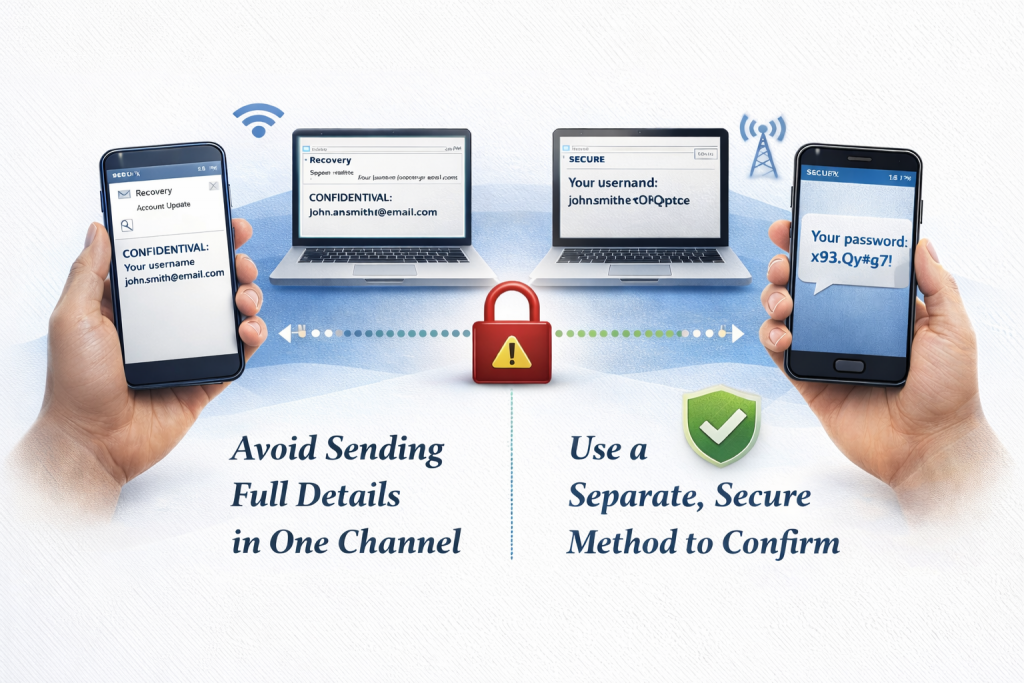
A classic and easy-to-understand example of out-of-band communication is sending sensitive information using multiple channels.
Imagine you need to securely share an encrypted file with a colleague:
- The file is sent via email.
- The password is sent via a different channel, such as a messaging app or a phone call.
Even if an attacker intercepts the email, the data is useless without the password. The security of the exchange does not depend on a single channel remaining secure.
You can further strengthen this approach by:
- Splitting the password into two parts.
- Sending each part over a different channel.
Now an attacker would need to compromise multiple independent systems at the same time. That raises the difficulty significantly and often makes the attack impractical.
This principle is the foundation of out-of-band security.
Out-of-band authentication
Out-of-band authentication applies the same idea to identity verification. A user logs in through one channel, such as a web browser. Verification happens through another channel, such as:
- A mobile push notification
- A one-time code generated on a separate device
- A phone call approval
If an attacker steals the user’s password through phishing or malware, they still cannot authenticate without access to the second channel. The authentication process is no longer dependent on the compromised path.
Out-of-band management and monitoring
Out-of-band is not limited to authentication. It is also widely used in infrastructure and operations.
Out-of-band management allows administrators to access and control systems using a dedicated management interface that is separate from the production network. This is critical when:
- The operating system is down
- The network is misconfigured
- The system is under active attack
Examples include dedicated management ports on servers, separate management networks, or console access through secure gateways.
Out-of-band monitoring and alerting ensures that security teams can still receive alerts when the primary environment is compromised. If attackers disable logging or monitoring on the main network, alerts sent through an independent channel can still reach responders.
Security benefits of out-of-band approaches
Out-of-band controls provide clear and measurable security benefits:
- Resilience: Security operations continue even during outages or attacks
- Attack containment: Compromise of one channel does not automatically compromise everything
- Reduced blast radius: Stolen credentials or intercepted traffic have limited value
From a governance and risk perspective, out-of-band controls demonstrate thoughtful threat modeling and defense-in-depth.
Final thoughts
Out-of-band in information security is about separation, independence, and resilience. It acknowledges a hard truth: networks get compromised, systems fail, and attackers find ways in.
By moving critical security actions outside the primary channel, organizations reduce risk, limit damage, and maintain control when it matters most.
Out-of-band is a practical, proven technique that makes all the difference.