

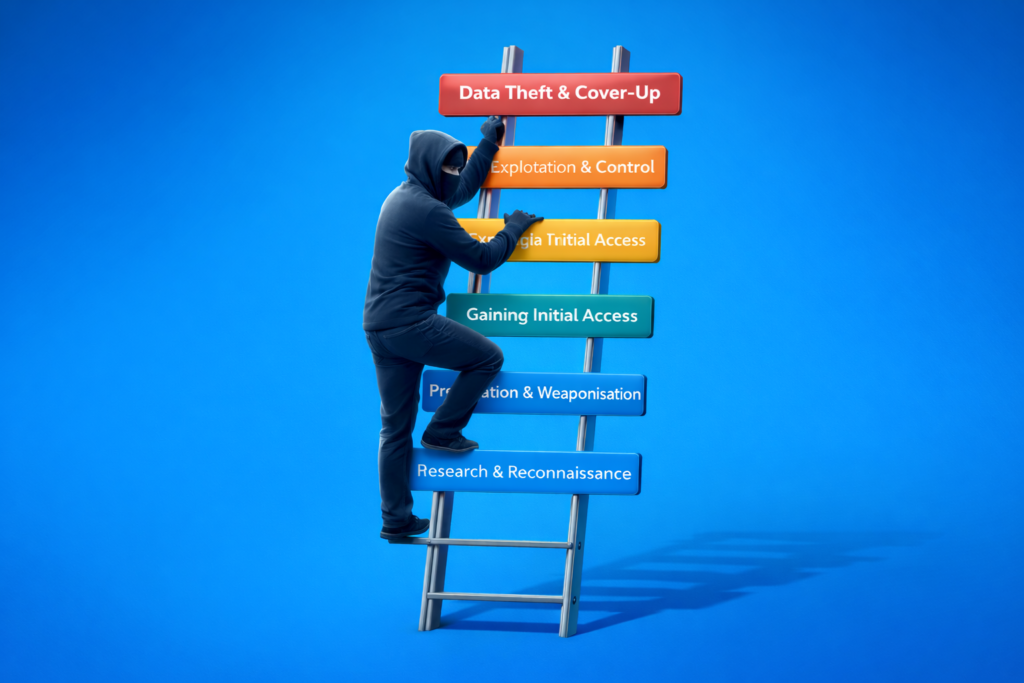
Preventing a breach is far more complicated than most people assume. There is rarely a single point of failure. Instead, attackers succeed because they follow a structured process. They study their targets, prepare carefully, and move step by step until they achieve their objective.
This is why effective cybersecurity begins with understanding how attackers think, plan, and execute. When organisations understand what hackers are looking for and how they move through a network, they can prioritise the right protections and detect threats much earlier.
Most cyber attacks follow a recognisable pattern, often referred to as a “kill chain”. Looking at this process provides valuable insight into where security efforts should be focused and which weaknesses attackers are most likely to exploit.
The Five Stages of a Cyber Attack
Stage One: Research and Reconnaissance
The first stage of any attack begins long before a system is touched. Attackers start by gathering as much information as possible about their target. This phase is sometimes called footprinting because the goal is to map out the organisation’s digital presence.
Hackers aim to understand what systems are in place, what data is valuable, how defences are structured, and where potential weaknesses may exist. The more detailed their knowledge, the easier the attack becomes.
Reconnaissance typically falls into two categories: passive and active.
Passive reconnaissance involves collecting information without directly interacting with the target. Attackers often rely heavily on open-source intelligence. Public records, press releases, and annual reports can reveal organisational structure, leadership details, and operational priorities. Social media profiles frequently expose employee roles, internal tools, and behavioural patterns that can later be exploited.
Email harvesting is another common technique at this stage. Attackers gather corporate email addresses using automated tools, public directories, or data leaks. These addresses are later used in phishing campaigns or credential attacks. Even job postings can provide valuable intelligence by revealing which technologies an organisation relies upon and where skill shortages may exist.
Active reconnaissance involves direct interaction with the target environment. Although riskier, it provides much more precise technical information. Attackers may conduct network scans to identify live systems, understand network architecture, and detect security controls such as firewalls or intrusion detection systems.
Port scanning is frequently used to determine which services are exposed and what software versions are running. This information allows attackers to identify known vulnerabilities or plan customised exploitation strategies.
Stage Two: Preparation and Weaponisation
Once sufficient intelligence has been gathered, attackers move into preparation. At this point, they begin designing methods to exploit the specific weaknesses they have identified.
This stage often involves crafting convincing phishing emails, building fake websites designed to capture credentials, or developing malicious software tailored to the target environment. The nature of the attack depends heavily on what was discovered during reconnaissance.
Attackers rarely rush this phase. In many cases, they spend considerable time refining their tools to ensure they can bypass security controls and avoid detection once the attack begins.
Stage Three: Gaining Initial Access
The next step is obtaining a foothold within the target environment. This is often achieved through surprisingly simple means. Human behaviour and weak security practices are frequently the easiest entry points.
An employee clicking a malicious link, opening an infected attachment, or unknowingly revealing login details can provide immediate access. In other cases, attackers exploit unpatched vulnerabilities or misconfigured systems that allow them to bypass defences.
Sometimes, attackers simply locate exposed login portals and use stolen or guessed credentials to gain entry. At this stage, they effectively become an authorised user within the network.
Stage Four: Exploitation and Control
After gaining access, attackers rarely stop there. Their next objective is to expand their control within the environment. This involves increasing privileges and ensuring they can remain inside the system for as long as possible.
Privilege escalation allows attackers to perform actions normally restricted to administrators, such as installing software, altering configurations, or accessing sensitive data. They may achieve this by exploiting system weaknesses, stealing additional credentials, or abusing legitimate administrative tools.
Maintaining persistence is equally important. Attackers often create hidden accounts, modify security settings, or install backdoors that allow them to return even if the original entry point is closed. At this stage, they may also move laterally across the network to identify valuable systems and data.
Stage Five: Data Theft and Cover-Up
Once attackers reach their objective, they begin extracting data or carrying out their intended action, whether that involves theft, disruption, or espionage. Data may be transferred gradually to avoid detection, encrypted for ransom, or prepared for sale on underground markets.
However, the attack does not end with data exfiltration. Skilled attackers take deliberate steps to erase evidence of their presence. They may delete logs, remove malicious tools, and alter records to make investigation more difficult.
This concealment allows them to remain undetected for longer periods, increasing the overall impact of the breach.
Why Understanding This Stages of Cyber Attack Matters
Cyber attacks are rarely sudden or random. They are typically slow, operations carried out in stages. By understanding this process, organisations can identify early warning signs, strengthen defences at critical points, and respond before an intrusion escalates into a full-scale breach.
In cybersecurity, knowing how attackers operate is one of the most important advantages any organisation can have.