

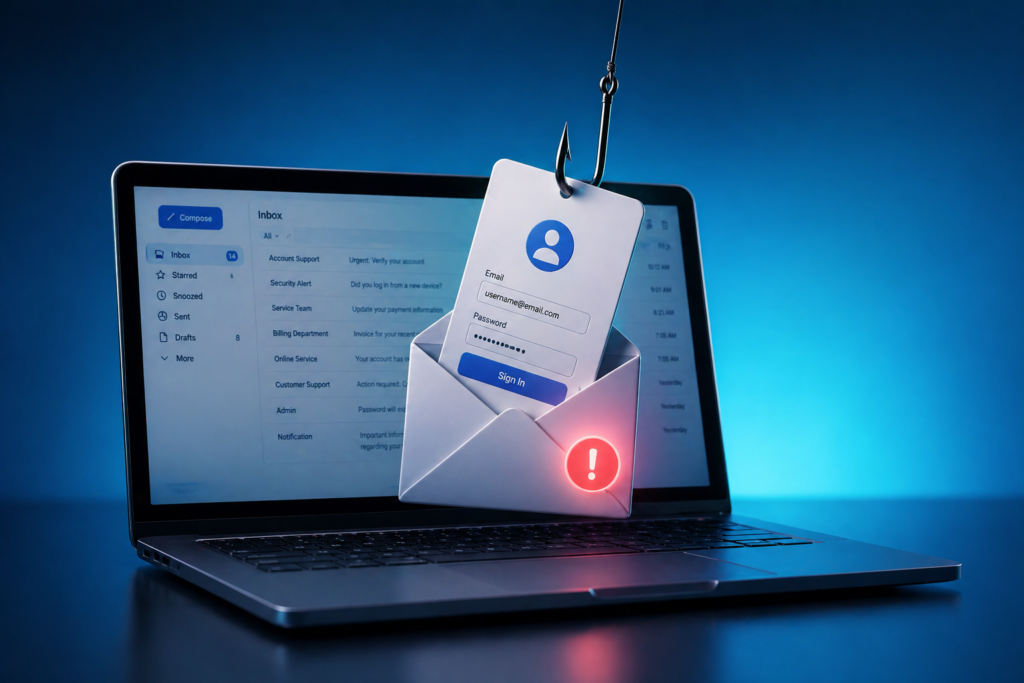
You might ask yourself: why, in the most technologically advanced time in human history, do we still fall for phishing links? We have advanced artificial intelligence, zero-trust architectures, biometrics, and strong encryption yet it still takes just one message, phone call, or link for everything to fall apart.
The uncomfortable truth is this: cybercriminals are not hacking your device; they are hacking human behaviour. Attackers have shifted from exploiting technical vulnerabilities to exploiting psychological and biological weaknesses in people.
What Is Phishing?
Phishing is a type of social engineering attack in which cybercriminals send fraudulent emails, messages, phone calls, or links designed to trick users into revealing sensitive information or installing malicious software.
The National Cyber Security Centre (NCSC) defines phishing as when criminals use scam emails, text messages, or phone calls to deceive victims. The goal is often to make you visit a website that may install malware on your device or steal bank details and other personal information.
Types of Phishing Scams You Must Know About in 2026
Phishing scams in 2026 do not look suspicious. They look exactly like messages you have received before or are expecting. That familiarity is the attack.
Email Phishing
Email phishing remains one of the most common forms of attack. Some emails claim there is a problem with your account; others say you need to update your details or that a recent payment has failed.
They often appear completely legitimate, from the sender’s address to the logos and formatting. However, a single click can lead to a fake login page designed to steal your credentials.
These scams rely heavily on urgency. For example, you may receive a warning about an unpaid bill. The email includes a link to a site that looks genuine and asks for your card details or login credentials. Once entered, attackers can gain full access to your accounts.
Search Engine Results and Social Media Ads
Scams do not exist only in emails and text messages. Clicking on a social media advert or even a search engine result can lead you to a fraudulent website.
Attackers sometimes place fake CAPTCHA tests on these sites. You might be asked to “prove you are not a robot”, but instead of verifying your identity, the action may trigger a malware download.
AI-Driven Scams
Advanced AI has significantly increased the capabilities of cybercriminals. As the technology evolves, scams are becoming more convincing and harder to detect. Voice cloning can now mimic real people with high accuracy, while deepfakes can impersonate high-profile individuals. AI makes these scams faster to create and more believable.
When we see or hear something familiar, a known voice or face, our natural scepticism tends to drop. That is exactly what attackers exploit.
What to Do Immediately After Clicking a Phishing Link
If you believe you have clicked a phishing link, act as quickly as possible.
Stay calm and act quickly
Phishing links do not always show immediate signs of compromise. Treat the situation seriously, even if nothing appears wrong.
Disconnect from the internet and avoid entering information
Disable Wi-Fi, unplug network cables, or switch your device to aeroplane mode. This can prevent malware from communicating externally or spreading.
If a login page or form appears, do not enter any credentials or personal information.
Run a full malware scan
Use trusted antivirus or endpoint protection software to scan your system. If threats are detected, follow the recommended remediation steps or seek professional help.
Change passwords immediately
If your credentials may have been exposed: Change passwords for affected accounts, update any accounts using the same password and use strong, unique passwords for each service
Enable multi-factor authentication (MFA)
Enabling MFA wherever possible is strongly recommended. It significantly reduces the risk of account compromise, even if passwords are stolen.
Back up important data
Ensure your data is backed up and stored securely, either offline or in a protected cloud environment.
Conclusion
Phishing continues to succeed because human behaviour remains predictable under pressure. Attackers understand urgency, trust, fear, and curiosity, and they consistently design their attacks around these reactions.
As cyber defence systems become more advanced, so do the methods used to bypass them. This creates a shifting battlefield where the weakest link is rarely the system itself, but the moment a human is convinced to act without verification.
This means security can no longer rely only on tools, filters, or infrastructure. It must also be built on awareness, disciplined habits, and consistent verification practices. Every unexpected request, every urgent message, and every unfamiliar link should be treated as a potential test of judgement, not convenience.