

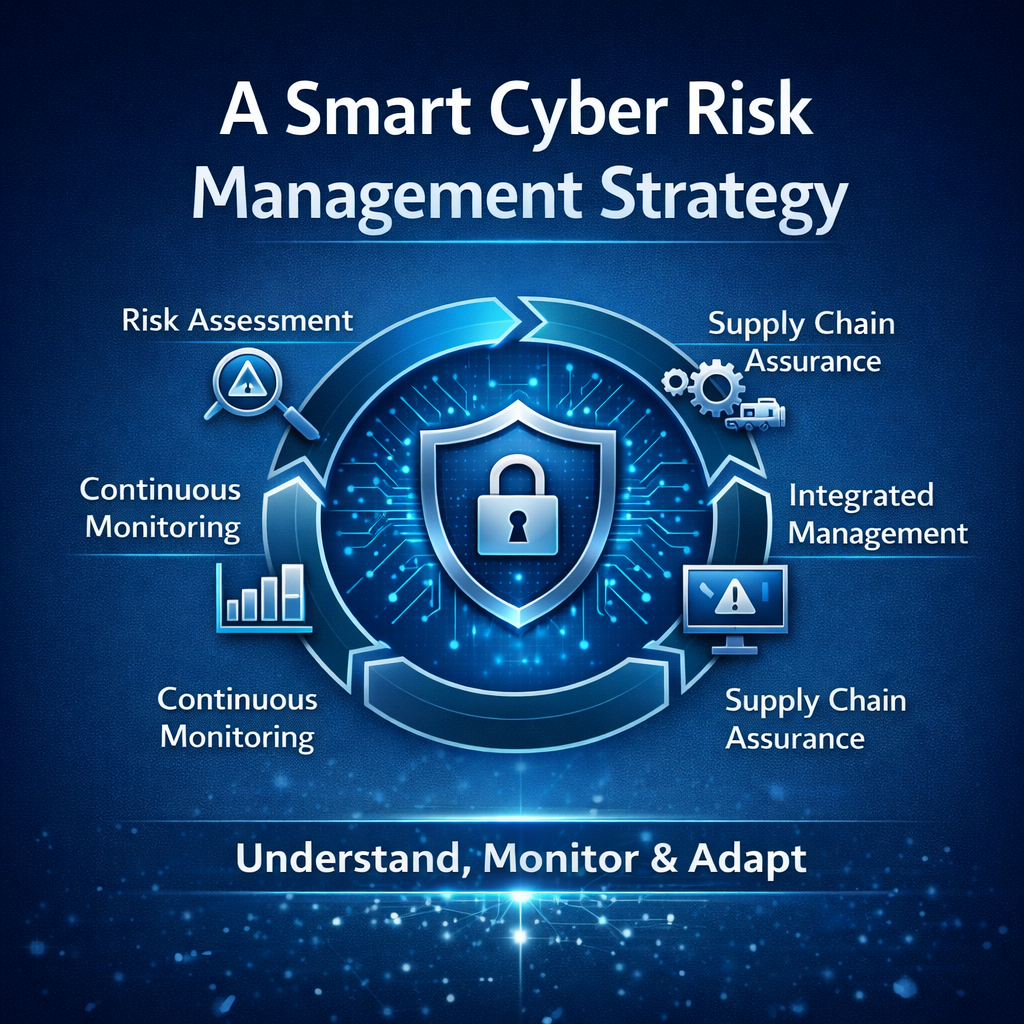
Cyber risk is a core business concern. It affects operations, supply chains, customer trust, and regulatory exposure. As a result, cyber risk management can no longer sit only with IT or security teams. It must be understood and owned across the organization.
Senior leaders increasingly recognize this shift. Cybersecurity ranks among the most significant organizational risks, alongside issues that directly threaten continuity and survival. This means cyber risk decisions must be made with the same discipline applied to financial, operational, and safety risks.
Start With Risk, Not Technology
A smart cyber risk management strategy does not begin with tools.
One of the most common mistakes organizations make is adopting technology before clearly defining the problem they are trying to solve. New platforms are deployed, dashboards are built, and data is collected yet decision-making does not improve.
Risk management should begin with simple questions:
- What could realistically go wrong?
- Which systems or processes would cause the most harm if they failed?
- Where are we currently blind?
Only after these questions are answered does technology become useful. Tools should support decisions, not exist for their own sake.
Use Data to Understand Where Risk Actually Lives
Not all risks are equal, and not all parts of the environment deserve the same level of attention.
Operational data, security events, vulnerability trends, and supplier information can be used to show where failures are more likely to occur and where their impact would be greatest. This allows organizations to focus their time and resources on areas where the stakes are highest.
This approach also reduces bias. Risks that feel urgent are not always the most dangerous. Data helps separate perception from reality and supports more consistent decision-making.
Move Away From Fixed, Schedule-Driven Assurance
Traditional audits and annual risk assessments provide limited value in a constantly changing environment. They capture a moment in time and quickly become outdated.
If certain components, systems, or suppliers demonstrate higher likelihood of failure, they should be reviewed more frequently and in greater depth. Lower-risk areas can be monitored using lighter-weight methods. This improves efficiency without reducing control.
The goal is not to audit everything equally, but to assure what matters most.
Continuous Monitoring Is No Longer Optional
Cyber threats evolve continuously. Ransomware and phishing, in particular, has increased in both frequency and sophistication and is increasingly used to target supply chains. These attacks often spread quietly before activating, making delayed detection especially costly. In this context, point-in-time assessments are not enough.
Continuous controls monitoring allows organizations to track key indicators in near real time. This includes internal security controls, system changes, and relevant data from suppliers. When implemented properly, this approach supports earlier detection and faster response.
Dashboards and threat intelligence platforms are useful here but only when aligned to clearly defined risks.
Cyber Risk Extends Into the Supply Chain
Most organizations depend on third parties for critical services, systems, and data. This makes supplier cyber risk part of the organization’s own risk profile.
A smart strategy includes supply chain assurance from the onset. This means understanding which suppliers are critical, what access they have, and what controls are expected of them.
Standards such as ISO 27001 and frameworks like the NIST Cybersecurity Framework provide a shared reference point. They also support collaboration, allowing organizations to raise security maturity across the supply chain rather than treating suppliers as isolated risks.
Integrate Cyber Risk Into How the Business Changes
Digital transformation increases both opportunity and exposure. When change is rushed or poorly governed, weaknesses are introduced.
Cyber risk management must be integrated into change management, not applied after. Security assurance, risk assessment, and resilience planning should evolve alongside new systems and processes.
When risk management is fragmented or handled in isolation, controls fail quietly. When it is integrated, weaknesses are identified earlier and corrected with less disruption.
What “Smart” Really Means
A smart cyber risk management strategy is deliberate and not complex or noisy.
It focuses on understanding risk before deploying solutions.
It uses data to prioritize effort.
It replaces static reviews with continuous insight.
It recognizes that suppliers are part of the risk landscape.
And it treats cyber resilience as an ongoing discipline, not a one-time exercise.
That is how organizations move from reacting to cyber incidents to managing cyber risk with confidence.