

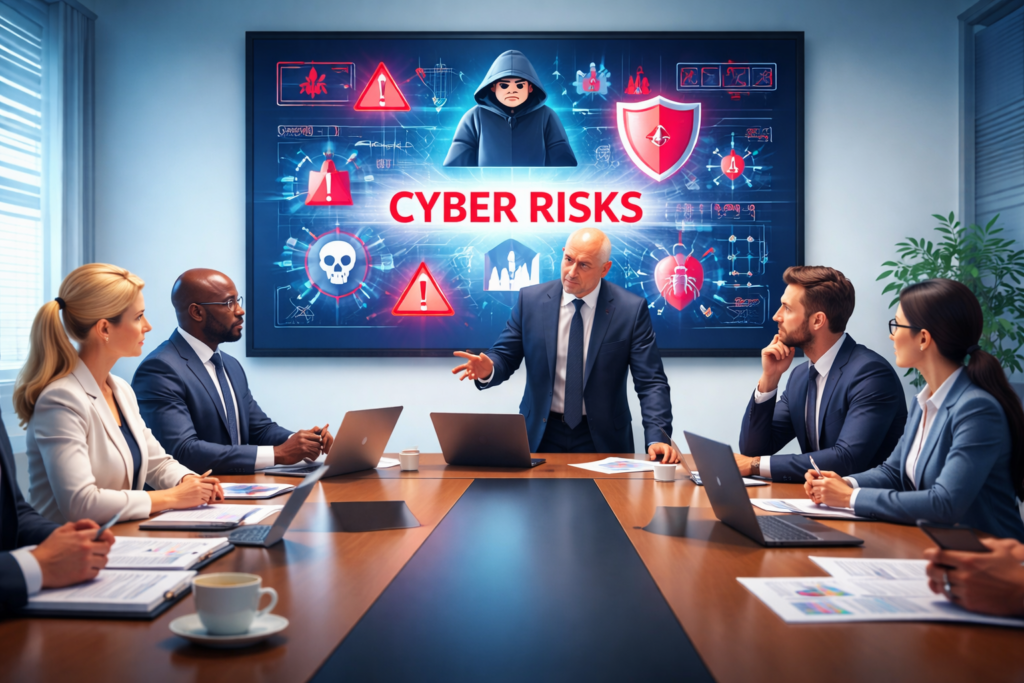
In cybersecurity, the goal has never been to prevent every attack. The real objective is ensuring the organisation can keep operating even when an attack succeeds.
In recent years, the nature of cyber incidents has changed. For a long time, stolen data dominated headlines. Now, the bigger story is operational disruption, when cyber incidents stop the business and operations.
This shift signals that cyber risk is no longer just a technology issue but a business resilience issue.
Looking ahead, there are five major cyber risks boards should treat as strategic priorities because they directly affect operations, supply chains, trust, and long-term stability.
1. AI Is Accelerating Cybercrime
Artificial intelligence (AI) is rapidly changing how cyberattacks are carried out. Attackers can now automate large portions of their operations. AI tools help generate convincing phishing emails, scan systems for weaknesses, and run attacks continuously without the same manual effort required in the past. AI is also changing what attackers choose to target as modern organisations run on data and executives rely on AI-assisted insights to make operational and strategic decisions every day. When attackers gain access to systems, they no longer need to cause obvious disruption to create damage. Sometimes, quietly manipulating the underlying data is enough.
If key metrics are altered, even slightly, the organisation may begin making decisions based on flawed information. By the time leaders realise something is wrong, the consequences may already be significant.
This is why AI-enabled cyber threats are increasingly undermining trust in the information that organisations rely on to run the business.
2. Third-Party Risk Has Become First-Party Risk
No modern company operates alone. Most rely on an extended ecosystem of cloud providers, software vendors, suppliers, contractors and managed service providers. Data moves constantly across these relationships.
Attackers understand this ecosystem very well. Instead of attacking the primary organisation directly, they often look for weaker partners in the supply chain. The challenge is that when something goes wrong, customers rarely care where the attack started. They hold the organisation responsible. If a supplier is compromised and your customer data is affected, the reputational damage still lands on the organisation. Regulators, customers and the media will not separate the two.
For boards, this means supply chain risk must be treated as an extension of internal security.
3. Geopolitics Is Reshaping Cyber Risk
Cybersecurity does not exist in isolation from global politics. Tensions between nation-states increasingly influence the cyber threat landscape. Organisations operating across multiple regions may find themselves caught between political interests, sanctions, or digital espionage campaigns. State-aligned actors often pursue objectives beyond financial gain. Their goals may include disruption, intelligence gathering, or strategic pressure. This creates a very different risk profile compared to ordinary cybercrime.
Cross-border incidents also complicate response efforts. Different jurisdictions may impose different regulatory requirements, legal restrictions, and reporting obligations.
For multi-national organisations, cybersecurity strategy must now include geopolitical awareness.
4. Operational Fragility
Perhaps the most underestimated risk is operational fragility. Operational fragility describes a situation where an organisation’s processes, systems, or workforce are so tightly coupled that even a small disruption can have disproportionate consequences. In other words, the organisation may appear stable during normal operations but struggles to absorb shocks when something unexpected happens.
This vulnerability has grown over time as businesses have embraced digital transformation. Identity platforms, cloud services, collaboration tools, supply-chain applications, and production systems are now deeply interconnected. While this connectivity improves efficiency, it also increases dependency.
When one critical component fails, the effects rarely remain isolated. The disruption can quickly ripple across other systems and processes, affecting teams, suppliers, and customers at the same time.
Many organisations only realise the extent of these dependencies during a crisis. A system that once seemed secondary suddenly proves essential to daily operations. Recovery becomes slower and more complicated than expected because too many processes rely on that single component. This is why resilience experts often advise organisations to define what can be called the “minimum viable company.”
This simply means identifying the few systems, processes, and pieces of data the organisation absolutely needs in order to keep running during a disruption. Once these essentials are clear, they can be given the highest priority for protection and recovery.
Without this understanding, organisations may only discover how dependent they are on certain systems when a major incident is already unfolding, when there is very little time left to respond.
In Conclusion
AI, supply chain risk, geopolitics and operational fragility may appear as separate challenges. In reality, they are deeply interconnected. Boards that view them through a single lens will be far better prepared for what lies ahead because the real measure of cybersecurity is not whether attacks occur. It is whether the business can continue to function when they do.