

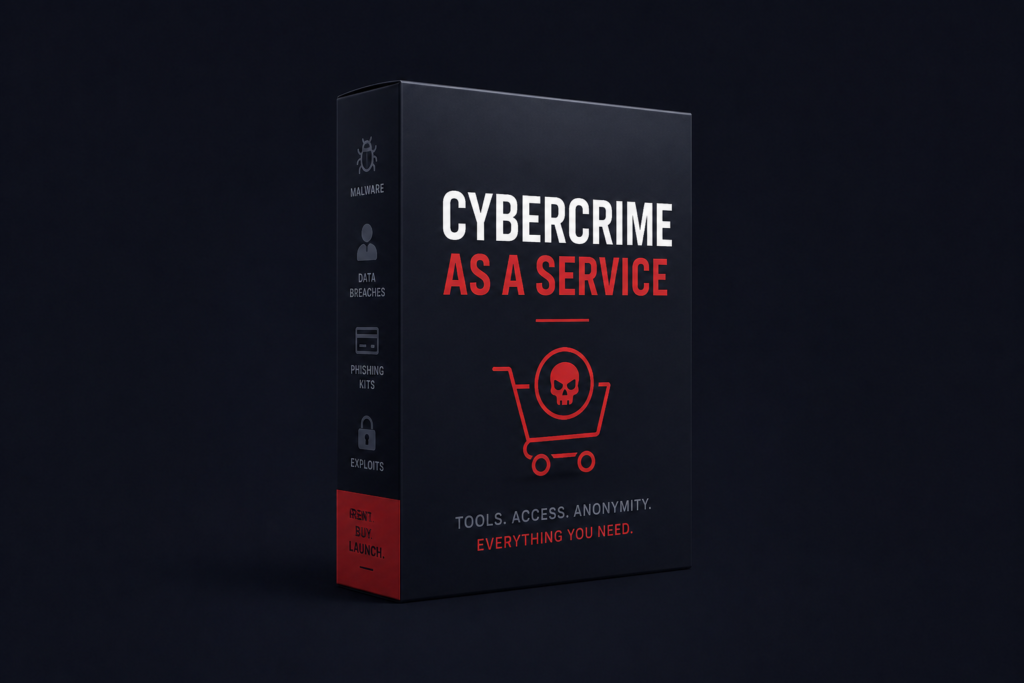
Cybercrime-as-a-Service (CaaS) is a business-style model used by cybercriminals in which hacking tools and illegal cyber operations are sold or rented as services.
In the past, launching a cyberattack required advanced technical expertise. Today, experienced cybercriminals develop attack tools, maintain infrastructure, and provide technical support, then offer these capabilities to others for payment. As a result, individuals with little or no hacking knowledge can carry out sophisticated attacks simply by purchasing access.
In this model, skilled criminals act as service providers, while buyers become customers who use these services to target victims. Cybercrime has therefore evolved from isolated hacking activity into an organised digital economy.
How CaaS Works
Cybercrime-as-a-Service operates by giving attackers access to ready-made cyberattack tools through purchase, rental, or subscription models. Instead of creating malware themselves, attackers rely on services provided by specialised criminal groups.
These services are typically advertised through underground marketplaces, encrypted messaging platforms, and closed criminal forums. The structure closely mirrors legitimate Software-as-a-Service (SaaS) businesses, except the products are designed for malicious purposes. This commercialisation has made cybercrime scalable, efficient, and accessible to a much wider audience.
Common examples include phishing kits that imitate legitimate websites to steal credentials, ransomware packages that encrypt data and demand payment, distributed denial-of-service services that overwhelm online platforms with traffic, and criminal infrastructure services that provide hosting, command-and-control systems, and anonymisation tools.
Why Defending Against CaaS Is Challenging
Defending against modern cyber threats has become significantly more difficult because cybercrime is no longer limited to highly skilled hackers. Organised cybercrime ecosystems now operate like mature businesses where tools, infrastructure, and expertise are available on demand.
One major challenge is the growth of a thriving underground ecosystem. Attackers can quickly obtain malware, phishing platforms, stolen credentials, and attack infrastructure. Even when law enforcement disrupts one group, others quickly replace it, allowing the ecosystem to continue operating.
Another difficulty lies in shared responsibility. Cybersecurity depends on individuals, organisations, and governments working together, yet their priorities often differ. Organisations may prioritise growth over security investment, users favour convenience over safe practices, and regulators frequently respond only after threats have evolved. These gaps create opportunities that attackers exploit.
There is also an information imbalance. Cybercriminal communities actively share tools, techniques, and intelligence, enabling rapid innovation. Defenders, by contrast, often operate reactively, responding to threats after they have already emerged.
Finally, cybercrime has become industrialised. Different groups now specialise in specific roles such as malware development, access brokerage, attack execution, ransom negotiation, or money laundering. This division of labour allows large-scale operations to run efficiently without any single actor needing to master every skill.
Defending Against Cybercrime-as-a-Service
Effective defence requires moving away from purely preventive security towards continuous resilience. Organisations must assume that attacks will eventually occur and focus on early detection, rapid response, and limiting impact. Identity protection has become particularly important because many CaaS attacks target user credentials. Strong authentication, least-privilege access, and monitoring of unusual login activity provide powerful defensive layers.
Human awareness remains equally critical. Many attacks still depend on social engineering, making user education an essential control rather than an optional one.
Technical defence must also evolve beyond traditional perimeter security. Continuous monitoring, endpoint detection, log analysis, and anomaly detection help organisations identify threats before they escalate. Maintaining timely software updates and effective vulnerability management further reduces opportunities for low-effort attacks that CaaS operators frequently exploit.
Because cybercrime functions as an ecosystem, defence must also be collaborative. Sharing threat intelligence and cooperating across industries, regulators, and law enforcement strengthens collective resilience.
Conclusion
Cybersecurity defence is no longer about stopping a single skilled hacker. It is about operating in a world where powerful attack capabilities are commercially available to almost anyone.
Success therefore depends on resilience, visibility, and preparedness rather than the assumption that attackers must possess advanced technical expertise to pose a serious threat.