

The cybersecurity skills gap is a present, measurable strain on organisations everywhere. Hundreds of thousands of cybersecurity roles remain unfilled, and the number keeps climbing year after year.
This persistent shortage creates a ripple effect. Employers across both government and private sectors struggle not only to recruit capable professionals but also to keep them. New digital risks emerge faster than skilled defenders can be trained, meaning demand consistently outpaces supply.
At the highest policy level, this challenge has become a national priority. The goal is not simply to produce more specialists, but to strengthen digital awareness across society, from universities to workforce development programmes.
This broader approach reflects an important reality that cybersecurity is no longer just a technical discipline. It is a human one.
Why Human Behaviour Sits at the Centre of Cyber Risk
Understanding how breaches actually occur tells a clear story. In reality, many cyber incidents do not begin with sophisticated technology failures. A good number of cyber incidents involve human actions.
These are not always complex mistakes. Sometimes they are as simple as clicking a deceptive link, trusting a fake request, or reusing weak credentials. In each case, a person interacts with a system in a way that unintentionally exposes the organisation to risk.
Technical controls will always remain essential, but they cannot fully compensate for human vulnerability. Attackers know this. That is why social engineering (manipulating people rather than machines) remains one of the most effective attack methods today.
If organisations want to reduce cyber incidents at scale, they must stop treating cybersecurity as the responsibility of Cybersecurity specialists alone. Every employee must understand basic digital safety practices.
This is where the concept of cyber hygiene becomes critical.
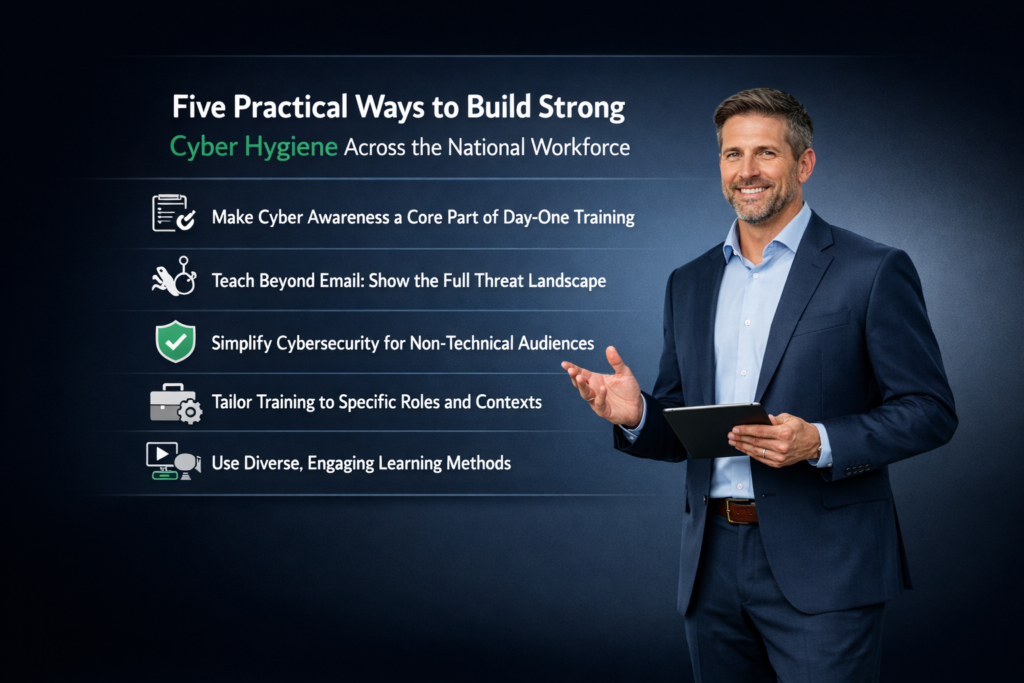
Five Practical Ways to Educate the Workforce on Cyber Hygiene
1. Make Cyber Awareness a Core Part of Day-One Training
Cybersecurity education should begin the moment an employee joins an organisation. It should not feel optional or secondary. It must sit alongside other foundational onboarding topics such as workplace conduct and safety.
Employees who will use email, digital systems, or cloud platforms should receive immediate, practical guidance. Given that the vast majority of malware is delivered through email, staff need to know how to recognise warning signs, such as suspicious links, unexpected attachments, or unfamiliar senders.
Simple habits can dramatically reduce risk; pausing to question whether an email was expected, verifying requests through another channel, and treating “too good to be true” messages with scepticism.
2. Teach Beyond Email: Show the Full Threat Landscape
While phishing dominates headlines, it is not the only risk. Employees must also learn how attackers operate through phone calls, impersonation, and manipulation outside digital systems.
Cyber awareness should therefore cover real-world deception tactics, not just technical threats. Staff need to understand that attackers exploit trust, urgency, and authority which are psychological triggers that can affect anyone.
When employees recognise these patterns, they become far harder targets.
3. Simplify Cybersecurity for Non-Technical Audiences
Many awareness programmes fail because they are designed by technical experts but delivered to non-technical audiences. The result is often overly complex content that employees disengage from.
Effective cyber education should feel accessible, relatable, and practical. Using real incidents, especially those that have previously affected the organisation. This makes the risks tangible rather than abstract.
When employees see how a simple mistake could disrupt operations, damage reputation, or cause financial loss, the message becomes far more compelling.
4. Tailor Training to Specific Roles and Contexts
Not every department faces the same cyber risks. Finance teams, HR staff, executives, and technical teams all encounter different types of targeted attacks.
Training should therefore reflect these realities. For example, finance personnel should be prepared to detect invoice fraud schemes, while senior executives must understand the risks of spear-phishing and impersonation attacks. Contextualised training improves relevance and relevance drives retention.
5. Use Diverse, Engaging Learning Methods
People absorb information in different ways. Some respond best to interactive exercises, others to short videos, simulations, or scenario-based learning.
Organisations should provide a variety of formats and deliver training regularly, not just once a year. Incentives like recognising employees who perform well in awareness exercises encourages positive engagement rather than fear. Crucially, cyber education should never feel punitive. The objective is to build confidence.
Conclusion
Strengthening cyber awareness across the workforce is not merely an organisational concern. Every employee who understands basic cyber hygiene becomes a frontline defender of digital infrastructure.
Even preventing a single incident caused by human error can save enormous costs, protect sensitive data, and preserve trust.
Ultimately, solving the cybersecurity talent shortage will require long-term investment in education and workforce development. But in the short term, one of the most powerful defences already exists: a well-informed workforce that knows how to recognise and avoid everyday cyber risks.