

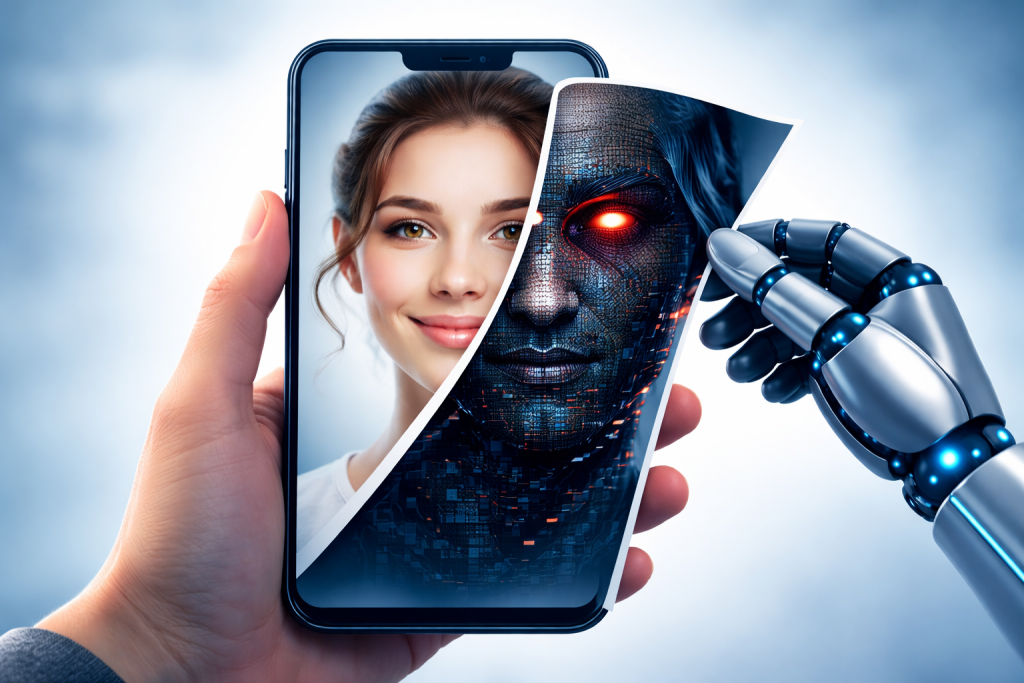
For years, photos, videos, and live calls have served as reliable proof of identity online. Seeing a familiar face or hearing a known voice was usually enough to establish trust. That assumption no longer holds.
Advances in synthetic media have made it possible to convincingly imitate real people in audio and video, quickly, cheaply, and at scale. What once required specialised research teams is now accessible through off-the-shelf tools. As a result, deepfakes are no longer a theoretical risk; they’re actively being used in fraud, social engineering, and account takeover attempts.
When realistic fakes become indistinguishable from genuine recordings, traditional trust signals stop working and both individuals and organisations are left guessing what’s real.
How Digital Trust is Being Eroded
Deepfakes work because they exploit a basic human instinct: we tend to trust what we can see and hear. Security systems were built around that same assumption. Video calls, voice verification, and biometric checks were never designed to question whether a “real-looking” person might not be real at all. That gap is now being actively exploited.
Attackers use synthetic audio and video to impersonate executives, colleagues, or trusted partners in real time as a short video call can be enough to pressure an employee into approving a payment, sharing sensitive data, or bypassing established procedures. Unlike traditional phishing emails, these attacks feel personal and urgent and they often happen too quickly for careful verification.
Beyond direct fraud, deepfakes introduce a broader problem: uncertainty. When realistic media can be fabricated on demand, confidence in digital communication weakens. Video evidence becomes questionable. Voice recordings lose authority. Even legitimate messages may be treated with suspicion.
Over time, this erosion of trust carries real costs, financial losses, reputational damage, and increased friction in everyday digital interactions.
Why Deepfakes Amplify Social Engineering
Social engineering has always relied on persuasion and context and deepfakes dramatically improve both.
Instead of relying on text messages or emails, attackers can now:
- Appear on video as a known person
- Speak with a familiar voice and tone
- React in real time to questions
- Create a sense of urgency that discourages verification
This makes traditional advice like “check the sender” or “look for spelling mistakes” far less effective. The attack doesn’t look suspicious, it looks convincing.
And once a single deepfake succeeds, it often enables further abuse. A compromised identity can be reused across departments, partners, or platforms, extending the damage far beyond the initial incident.
What Organisations Need to Rethink
Relying solely on visual or audio confirmation is no longer sufficient. In an environment where media itself can be forged, trust has to be based on more than appearances.
Effective defence requires moving away from one-time checks and toward continuous verification. Instead of asking, “Does this look real?”, systems need to assess whether behaviour, devices, and environments make sense together.
This includes:
- Monitoring for anomalies during live interactions
- Verifying that cameras and devices are genuine
- Detecting inconsistencies that synthetic media struggles to replicate
- Evaluating behaviour patterns rather than single actions
The goal is to detect subtle signals that indicate manipulation or automation.
Technology Alone Isn’t Enough
Even the best technical controls can fail if people don’t know how deepfake attacks work.
Employees should be trained to expect impersonation attempts including simulated video or voice scenarios and to pause when requests involve urgency, secrecy, or bypassing standard processes. Clear escalation paths matter. If staff aren’t sure who to call when something feels off, attackers gain an advantage.
Organisations also need clear internal rules around verification. For example:
- When is a video call sufficient to approve an action?
- When is secondary confirmation required?
- How should suspected synthetic media incidents be reported?
Without agreed-upon procedures, trust decisions are left to individuals under pressure.
Rebuilding Confidence Online
Deepfakes aren’t going away. As tools improve, synthetic media will become faster, cheaper, and harder to detect. That makes rebuilding digital trust a long-term challenge and not a one-time fix.
Sustainable trust will depend on several things working together:
- Detection technologies that adapt as attacks evolve
- Clear organisational processes for verification and escalation
- Awareness that “real-looking” no longer guarantees “real”
- Transparent communication about how identity is confirmed
In a world where audio and video can be convincingly forged, trust has to be earned continuously not assumed. The sooner organisations adjust to that reality, the better prepared they’ll be for what comes next.