

For years, organisations have struggled to balance strong security with everyday usability. Security controls only work if people can actually use them without constant frustration. This tension becomes particularly obvious when dealing with passwords.
Employees must log in to dozens of systems every day, yet organisations expect them to create strong, unique credentials for each one. When security policies become too complicated, people find shortcuts. Unfortunately, those shortcuts often become the exact weaknesses attackers exploit.
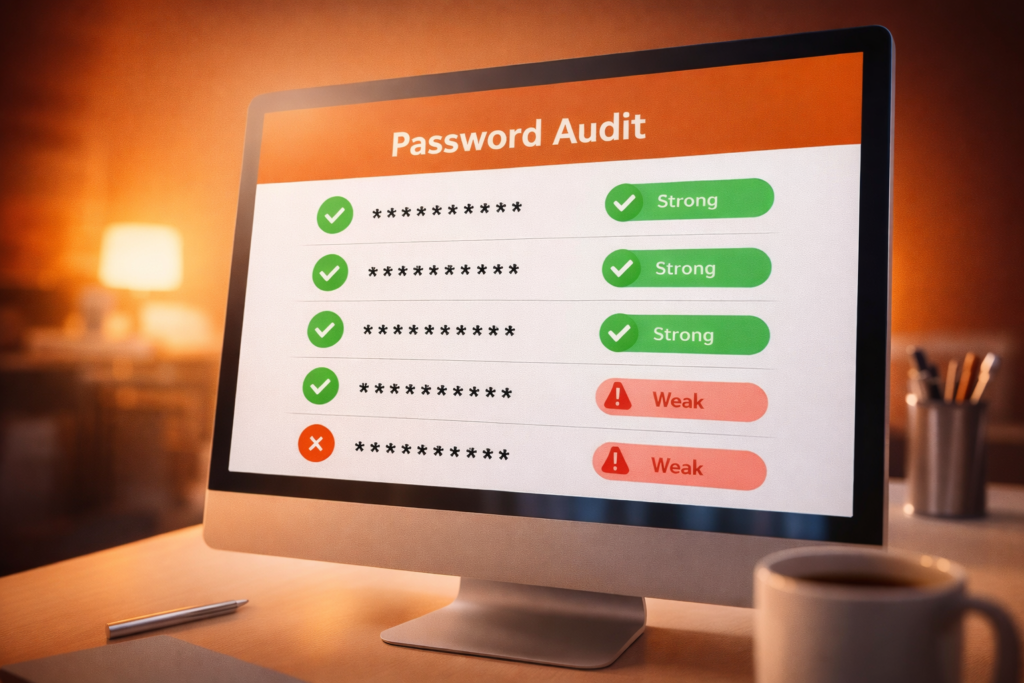
One of the most practical ways to improve password security is through regular password audits. These reviews help organisations identify weak credentials, uncover risky patterns, and strengthen their overall security posture before attackers take advantage of the gaps.
This article explains what password audits are, why they matter, and how they help protect modern organisations.
The Persistent Problem with Passwords
Despite advances in cybersecurity tools and authentication technologies, weak passwords remain one of the common causes of data breaches.
Large-scale data leaks continue to expose billions of credentials every year. Many of these exposures occur because of poor password habits such as:
- Reusing the same password across multiple accounts
- Choosing simple, predictable passwords
- Rarely updating credentials after long periods of use
When one compromised password unlocks multiple systems, attackers gain a powerful entry point into corporate networks.
Security researchers regularly uncover massive collections of stolen credentials circulating online. These databases often contain login details linked to major technology platforms and widely used online services. Once these credentials are exposed, attackers can automate login attempts across many different services, hoping users have reused the same password elsewhere. This is why password hygiene is so important.
What a Password Audit Actually Does
A password audit is a security assessment that analyses password data within an organisation’s identity systems. Its purpose is to identify weaknesses before attackers discover them.
Rather than waiting for a breach to reveal problems, a password audit allows security teams to proactively detect risky practices and fix them early.A thorough password audit typically reveals several types of vulnerabilities:
Compromised or Banned Passwords
Some passwords are already known to attackers because they have appeared in previous data breaches. These credentials are widely shared in hidden forums, darkweb and password-cracking databases.
A password audit can identify when employees are using passwords that already appear in breach lists or that are considered extremely weak. Removing these credentials immediately reduces the risk of automated credential-stuffing attacks.
Password Reuse Across Accounts
One of the most widespread security mistakes is password reuse. When employees use the same password across different systems, a compromise in one service can quickly spread to others. Attackers routinely test stolen credentials against multiple platforms to see where else they work.
A password audit can highlight repeated passwords across accounts, helping organisations enforce stronger credential policies.
Dormant or Stale Administrator Accounts
Inactive accounts are often overlooked, but they present a significant security risk. This is particularly dangerous when the accounts have administrative privileges. Attackers actively search for unused accounts because they often remain unmonitored and still retain elevated permissions.
A password audit can detect these accounts so they can be disabled or removed entirely.
Outdated Authentication Methods
Some organisations still rely on legacy authentication mechanisms that are no longer considered secure. Older password hashing methods or outdated authentication protocols can make it easier for attackers to crack credentials once they gain access to password data.
A password audit helps identify where outdated systems are still in use so they can be replaced with modern authentication standards or additional controls implemented to mitigate risks.
Forgotten Service Accounts
Service accounts are used by applications, scripts, and automated systems. Over time, these accounts can accumulate across an environment as applications are deployed, updated, or retired. If an application is abandoned but its service account remains active, it can become an unnoticed access point.
A password audit can detect these orphaned accounts and allow administrators to properly retire or secure them.
Fixing Weak Passwords After an Audit
Running a password audit is only the first step. The real value comes from remediating the weaknesses that the audit reveals.
Organisations usually take several approaches depending on the severity of the findings.
Large-Scale or Targeted Password Resets
In situations where a widespread weakness is discovered, organisations may require users to reset their passwords immediately.
This can be done in two ways:
- Bulk resets, where large groups of users are forced to change their credentials
- Targeted resets, where only accounts identified as risky are required to update their passwords
While bulk resets can contain an emergency situation quickly, targeted resets often create less disruption for employees.
Self-Service Password Reset Systems
Self-service password reset tools allow users to change their passwords without contacting the help desk. These systems typically require identity verification before allowing the reset process. This reduces the administrative workload for IT teams while enabling faster remediation when weak passwords are detected.
Temporary Account Lockdowns
If an account appears to be compromised or highly vulnerable, administrators may temporarily suspend access until the issue is resolved.
During this period, the user must complete a secure recovery process before access is restored. This precaution prevents attackers from exploiting weak credentials while remediation is underway.
Strengthening Password Policies
Long-term improvement requires stronger password policies. Modern password security policies often include:
- Minimum password length requirements
- Detection of commonly used passwords
- Blocking passwords found in breach databases
- Restrictions on dictionary words related to the organisation
When combined with user awareness training, these policies significantly reduce the likelihood of weak credentials entering the system in the first place.
Why Regular Password Audits are Important
Cyber attackers are constantly searching for small weaknesses they can exploit. Weak credentials remain one of the easiest paths into corporate networks.
Regular password audits help organisations close those gaps by:
- Identifying weak or compromised credentials
- Detecting risky password behaviour
- Highlighting forgotten or unnecessary accounts
- Providing clear guidance on where security improvements are needed
Rather than reacting after a breach occurs, password audits allow organisations to strengthen their defences proactively.
In an environment where attackers are continuously testing organisational security, ensuring that passwords are not the weakest link is a critical step toward a stronger cybersecurity strategy.