

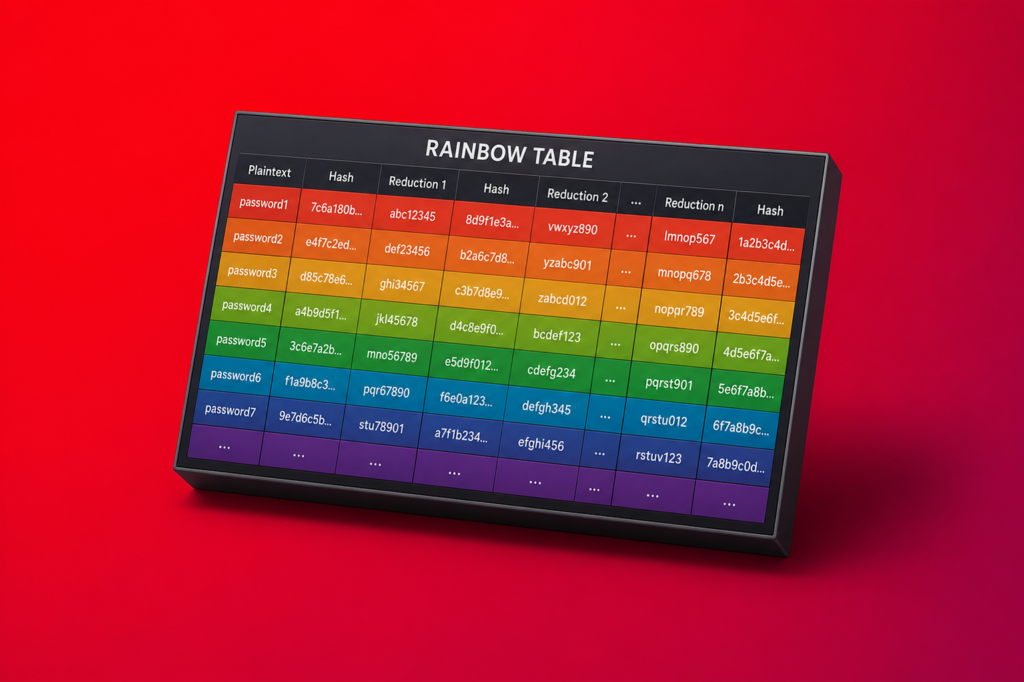
Back in the early days of password cracking, rainbow tables were considered one of the most effective shortcuts available to attackers. Instead of trying millions or billions of password combinations one by one, attackers could use enormous precomputed lookup tables that linked password hashes to their original passwords. In simple terms, rainbow tables acted like giant cheat sheets. If an attacker obtained a hash and that hash existed in their table, they could recover the original password much faster than by brute force.
For years, rainbow tables were viewed as a serious threat to organisations relying on older authentication systems. But in 2026, do they still matter? The answer is both yes and no.
Recent events have pushed rainbow tables back into the spotlight, but not because attackers suddenly started relying on them again.
Why Everyone is Talking About Rainbow Tables Again
Earlier this year, Mandiant released an enormous collection of Net-NTLMv1 rainbow tables totalling 8.6 terabytes. The release was intended to send a clear message to organisations still using NTLMv1: the protocol is no longer secure.
According to Mandiant, researchers could use these tables to recover authentication keys in less than 12 hours using relatively inexpensive consumer hardware. The announcement generated plenty of headlines and reignited discussions about rainbow tables across the cybersecurity industry.
How Rainbow Tables Actually Work
To understand why rainbow tables are less important today, it helps to understand what they were designed to do. When a password is stored securely, it isn’t usually stored in plain text. Instead, it is converted into a hash which is a unique string of characters generated by a mathematical function.
For example, two users could choose the same password and, depending on the system, end up with the same hash value. Rainbow tables exploit this predictability.
Attackers generate huge collections of passwords in advance, calculate their hashes, and store the results. Later, when they obtain stolen hashes from a target system, they simply search the table for a match. The process can be much faster than calculating every possible password from scratch.
The catch is that rainbow tables only work effectively under specific conditions. They are most useful against older systems that use weak hashing methods and do not add extra protections such as salting. This is exactly why protocols like NTLMv1 have become such a problem.
The Real Reason Attackers Don’t need Rainbow Tables Anymore
Rainbow tables became popular because computing power used to be expensive. Today, computing power is cheap. Modern graphics processing units (GPUs) can perform staggering numbers of calculations every second. Hardware originally designed for gaming has become powerful enough to process huge volumes of password guesses at remarkable speeds.
Cloud services have made this even easier. An attacker no longer needs to own expensive equipment. They can simply rent powerful hardware for a few hours whenever they need it. As a result, many attackers no longer bother carrying around massive databases containing terabytes of precomputed hashes. Instead, they crack passwords in real time.
If a modern GPU can test millions or billions of password combinations quickly enough, maintaining giant rainbow tables becomes less attractive.
What Attackers Use Instead
When most people imagine password cracking, they picture a hacker sitting behind a computer trying random combinations until something works. Modern attacks are far more efficient than that. Rather than guessing blindly, attackers often start with information that already exists.
Massive collections of passwords from previous data breaches circulate throughout cybercriminal communities. If a password has already been exposed somewhere else, there’s a good chance attackers already know it. This means many attacks no longer involve “cracking” passwords at all. Instead, attackers simply compare stolen credentials against databases of known passwords and see what matches.
When that doesn’t work, they turn to highly targeted password lists, rules that mimic common human behaviour, and increasingly sophisticated tools that can predict likely password patterns. These approaches are flexible. They work across different systems, different applications, and different types of password storage. Rainbow tables, by comparison, are highly specialised tools built for specific scenarios. That’s why many security researchers now view them as a relic of an earlier era.
Weak Passwords Remain the Real Problem
While rainbow tables generate attention, they are rarely the biggest threat facing organisations. Poor password habits remain far more dangerous. Many users continue to reuse passwords across multiple accounts. Others choose passwords that are predictable, easy to guess, or based on personal information.
When one of those passwords appears in a data breach, attackers can immediately use it against other accounts. At that point, there is no need for rainbow tables, advanced hardware, or sophisticated cracking techniques. The password has already been exposed.
This is one reason breached-password screening has become increasingly important. Organisations that check passwords against known breach databases can stop exposed credentials from being used before attackers have an opportunity to exploit them.
How Organisations Can Protect Themselves
The good news is that defending against modern password attacks does not require complicated solutions. The first step is eliminating outdated authentication protocols and moving to more modern alternatives wherever possible.
Organisations should also ensure passwords are stored using modern hashing methods that include salting and are deliberately designed to resist cracking attempts. Long passphrases are generally more effective than short, complex passwords. They are easier for users to remember and significantly harder for attackers to guess.
It is equally important to check passwords against known breach databases. If a password has already been exposed elsewhere, it should never be allowed into the environment in the first place.
Finally, organisations should deploy strong multi-factor authentication. Even if a password is stolen, an additional authentication factor can prevent attackers from gaining access.
So, Are Rainbow Tables Still Relevant?
Not in the way they once were. The recent NTLMv1 rainbow table release demonstrates how vulnerable outdated systems have become, but it does not signal a return to rainbow-table-based attacks.
Today’s attackers have access to enormous breach datasets, powerful cloud computing resources, advanced password-cracking tools, and increasingly sophisticated techniques for predicting human password choices. In most cases, those methods are faster, more flexible, and easier to use than maintaining multi-terabyte rainbow tables.
The real lesson for organisations in 2026 is to stop relying on technologies and password practices that belong to the same era.